

Leland Blue stones are a familiar subject for Leelanau County beachcombers, but their name hides an important distinction: these colorful finds are industrial slag rather than naturally formed gemstones.
Knowing that history helps explain why a blue fragment on the shoreline deserves a closer look without turning every unusual pebble into a confident identification.
Start with observation, permission and a realistic expectation that no beach guarantees a find.
A remnant of an industrial shoreline
The Omena Village Preservation Association’s history connects Leland Blues with the iron-smelting industry that operated in Leland during the nineteenth century.
As material was processed, the resulting slag was discarded, and pieces later became rounded through their time along the lakeshore.
The local story gives these objects a different origin from Petoskey stones, which are fossil coral.
Rather than viewing them only as souvenirs, consider what a fragment can reveal about the changing uses of the same waterfront.
Look beyond the brightest blue
The preservation association describes variation that can include purple, gray and green as well as blue, with possible swirls, bubbles, pits or rusty areas.
Those features can guide a closer comparison, but color alone is not proof of origin.
Photograph an unfamiliar piece from several angles, including a size reference, and record the general place where you observed it.
Use a tentative label when you cannot distinguish slag from another material.
Do not assume a polished item sold under a familiar name will look exactly like a weathered fragment on a beach.
Begin with a public beach walk
The Leland beach guide identifies Van’s Beach at the end of Cedar Street, with access just beyond Van’s Garage.
The preservation association names Van’s Beach and North Beach as places where visitors look for Leland Blues.
Treat those references as starting points for a shoreline walk, not a promise of collecting permission or a guaranteed supply.
Read posted signs and ask the responsible land manager about removal rules before taking anything.
Keep clear of private property, unstable banks and wave-washed areas, and be willing to leave with photographs instead of a specimen.
Know which land you are visiting
Nearby Sleeping Bear Dunes National Lakeshore has different rules from a village beach.
The National Park Service’s visitor guidance prohibits collecting natural, historical and archaeological items, with limited exceptions that do not create a general rockhounding allowance.
Do not transfer permission from one property to another simply because both are along Lake Michigan.
Public access, the right to walk and permission to remove material are separate questions to resolve at the actual site.
Build a useful record
A magnifier, phone camera, reusable water bottle and notebook can support careful observation without turning the outing into a bulk-collecting trip.
When handling a loose piece is permitted, compare the dry surface with the same surface lightly dampened, then keep the photographs connected to the correct find.
For more background, consult the Michigan Mineralogical Society’s collecting references and compare descriptions rather than relying on a single social-media picture.
Children can sketch the colors and shapes they notice, making the walk worthwhile even when no blue material appears.
The most useful discovery may be the connection between a present-day beach and the industrial history beneath its familiar scenery.
Leave the shoreline intact for the next visitor. |
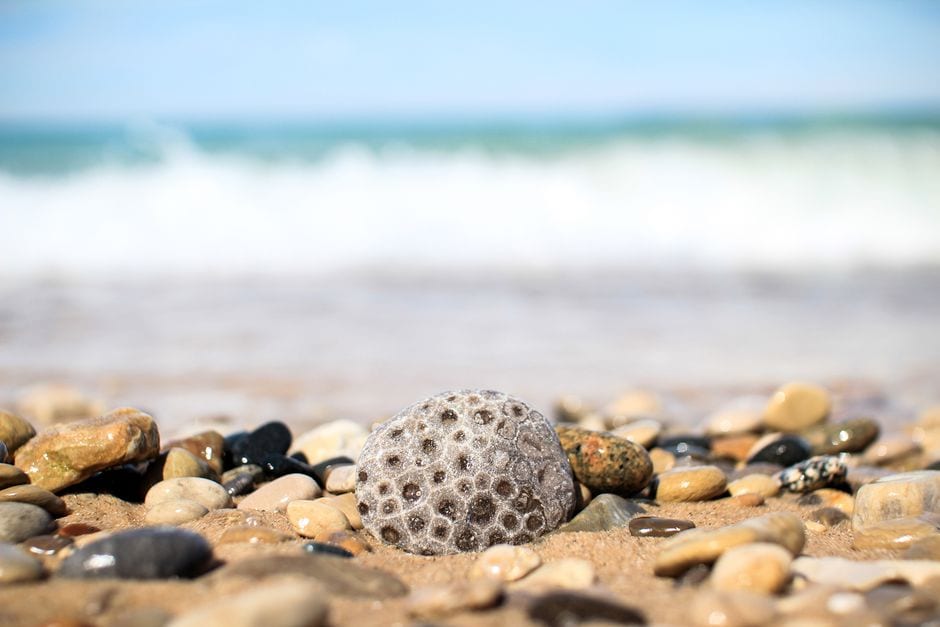 Photo by Brett Schaberg on Pexels — Illustrative beach-stone stock photograph; not Leland Blue and not an identification guide. |




0 Comments
Join the conversation
Be the first to comment
Share your thoughts above.